
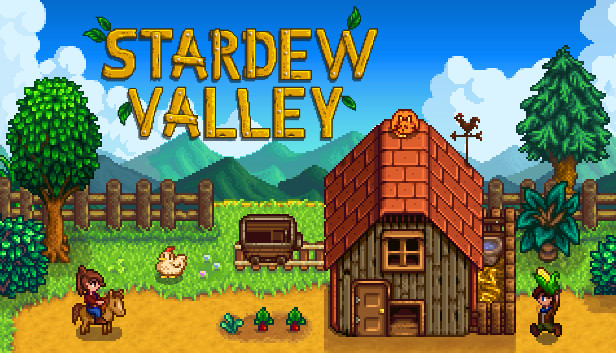
If Nguyen Binh Khiem once chose “one hoe, one spade, one fishing rod” to withdraw from the world, then Stardew Valley is that very philosophy reborn for modern office workers suffocating under deadlines. The game pulls you away from Excel spreadsheets and drops you into your grandfather’s old farm, where you are free to choose your own version of “foolishness”: tilling the soil by hand, sowing seeds, and patiently waiting for bamboo shoots to sprout and bean sprouts to rise.
Yet the “leisure” of Pelican Town is not about idle stillness—it is about being joyfully busy. You will find yourself waking early and staying up late, not for your boss’s KPIs, but to savor the simple pleasure of “eating bamboo shoots in autumn, bean sprouts in winter” brought to life. A seemingly simple pixel game, Stardew Valley gently reminds us that happiness sometimes lies in nothing more than a bountiful harvest and a life lived freely.
The Story of Stardew Valley
The narrative of Stardew Valley is more than a mere introduction—it is a clash between two ideologies: cold industrialization and the fundamental value of honest labor.
The story begins in the office of the Joja Corporation. Amid tightly packed cubicles and fluorescent lights that never turn off, you are nothing more than a cog in a money-printing machine run by corporate giants. The image of a skeleton slumped over a desk at the very start of the game is a powerful metaphor: if you don’t leave, that will be your future.
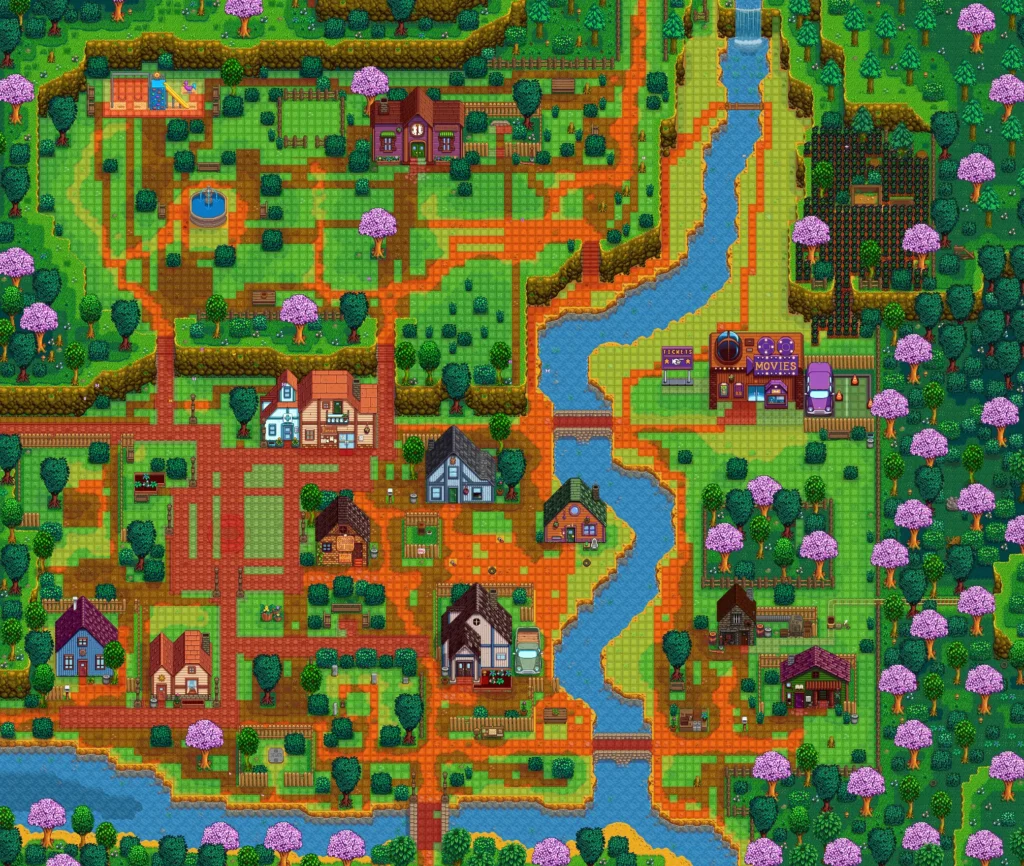
The grandfather’s letter doesn’t merely give you a farm—it gives you a “second life.” The moment you arrive in Pelican Town, you officially step into a challenging journey of leisure through living, marked by the following key milestones.
Chapters of a Rebirth Journey
- Chapter 1: The First Swings of the Hoe (Spring Awakens)
Inheriting the legacy:
You choose your starting point in nature—from classic farmland and peaceful riversides to the dense forest edge. This is where you confront a neglected yet promising plot of land.
Human connections:
Your first encounters with people like Clint the blacksmith or Mayor Lewis are more than casual greetings—they are the beginning of reconnecting with a living community.
Lessons in survival:
You learn to balance ambition with personal limits. When your stomach is empty and your wallet is dry, every point of stamina spent becomes a careful, exhausting—but rewarding—calculation.
Chapter 2: A Crossroads — Integrity or Compromise?
The pure path (Community Center route):
Patiently gathering the finest offerings of nature through Bundles. This is a demanding, almost ascetic path, but one that restores the soul of the countryside.
The temptation of money (JojaMart route):
Solving every problem with financial power. It’s convenient and fast—but are you unknowingly bringing the very corporate chains you once escaped back into this valley?
Chapter 3: Through the Darkness Below
An inward journey:
Descending hundreds of levels into the mines is not just about ore and minerals—it’s about confronting your deepest fears to uncover hidden diamonds within.
Distant horizons:
Stepping beyond the town’s borders to reach the Calico Desert. Here, Mr. Qi’s mind-bending challenges test who you truly are in the wider world.
Chapter 4: The Judgment of Sincerity
A response from the past:
When the spring of your third year arrives, your grandfather’s spirit returns as a mirror reflecting the entirety of your journey.
Redefining success:
Recognition is no longer measured by your bank balance, but by how you’ve cared for the land and treated the people around you throughout this life.
Gameplay
Gameplay: A Blissfully Exhausting Loop
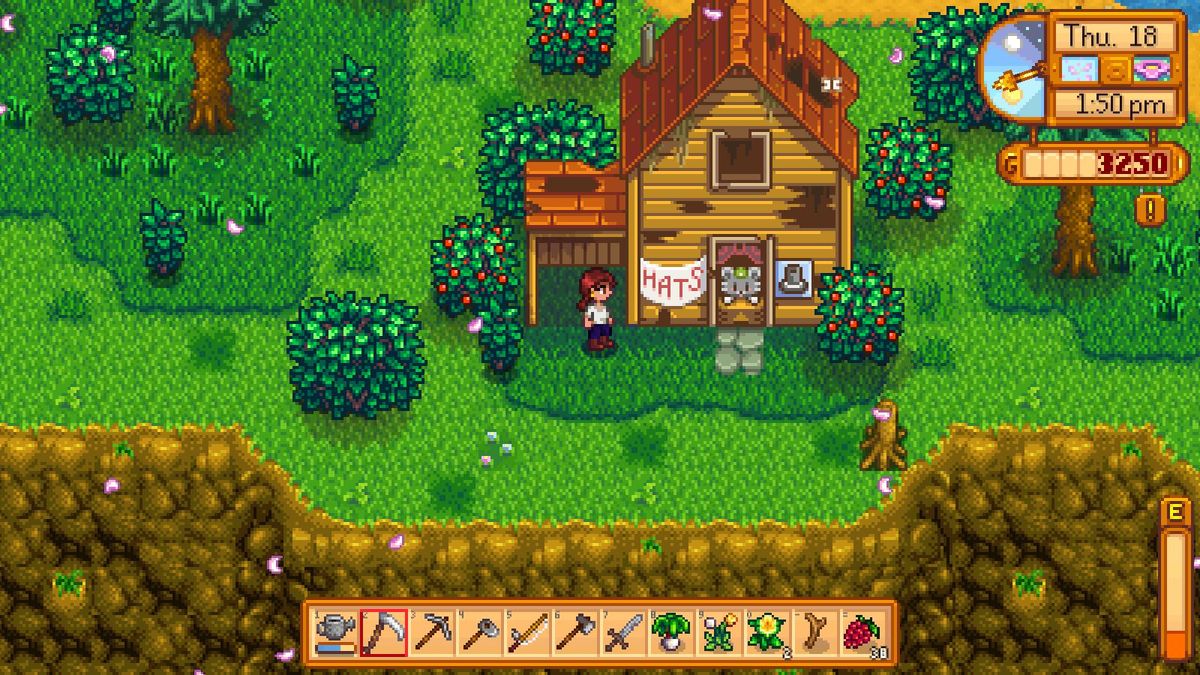
- Morning (6:00 AM): Wake up and skip brushing your teeth—your first task is hauling the watering can to water hundreds of watermelon plants. By the time you’re done, your green stamina bar is completely drained, and you’re gasping for air.
- Noon: Go “dumpster diving”—chop trees, smash rocks, and clean up a farm that looks more like a war zone than a peaceful homestead.
- Afternoon: Fishing time—the most rage-inducing activity in gaming history. The fish fights harder than an ex who suddenly turned cold. But landing a rare fish feels like winning the lottery.
- Evening: Sprint home before 2:00 AM. Miss it by even a second and you’ll pass out on the road, wake up the next morning with medical bills, and get lectured by Doctor Harvey.
“Quirky” Neighbors (NPCs)
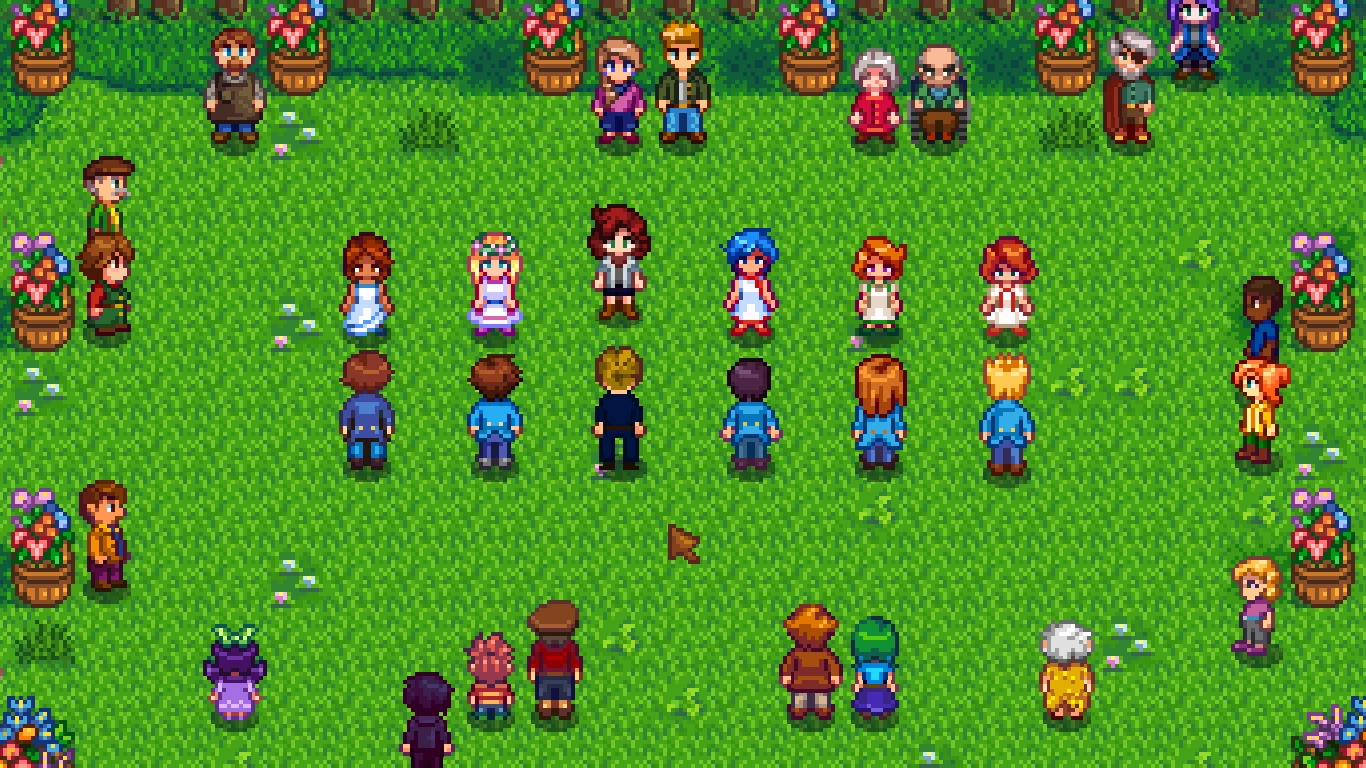
- Drama Corner: A Tiny Town Packed with Scandal
- Notable Characters:
- Shane: A hardcore alcoholic. Annoying at first, but once you get close, you realize his story is actually… pretty tragic.
- Abigail: The purple-haired girl whose hobby is eating quartz—literally. Apparently, her teeth are made of steel.
- Mayor Lewis: A respected town leader with a very questionable secret involving a pair of purple “lucky shorts.”
- The Romance Game:
- You shower people with gifts like there’s no tomorrow just to get married. But once you tie the knot, the real question is: will your spouse help water the crops—or just stand there watching you work like a slave?
- (This is where Stardew Valley really shines with its surprisingly realistic social interactions.)
Patience
Restoring this rundown house is the ultimate test of patience.
The pain:
Missing a single Spring Bean—because you sold it by mistake or missed the season—means waiting… an entire in-game year. There is no bitterness quite like it.
Lessons Learned
- Time management:
The game teaches time management better than some absurdly expensive online courses. - Respect for labor:
Even producing a single egg takes real effort and care—it doesn’t come for free. - Freedom:
You’re free to become a wine tycoon, or a wandering miner living off the depths of the earth. No one forces you down any path.
Should You Walk This Path?
The call:
“If you’re thinking about quitting the city to grow vegetables back home, come here and ‘apprentice’ first.”
Warning:
This game is not for anyone cramming for exams or racing against tight deadlines—because “just one more in-game day” easily turns into four real-life hours.
Final pitch:
For the price of three bowls of pho, you get a game that can last thousands of hours. If you don’t buy it, chances are—you’ve never truly experienced office burnout.
Core Activities & Their Philosophical Meaning
| Activity | Philosophical Meaning | Experience Details |
|---|---|---|
| Farming | Self-sufficiency | Planting, watering, fertilizing crops. Building greenhouses to grow out-of-season produce. |
| Ranching | Bonding with living beings | Raising chickens, cows, goats, and sheep. Caring for them to receive eggs, milk, and loyalty. |
| Mining | Inner exploration | The deeper you go underground, the stronger the monsters—but the rarer the resources. |
| Fishing | Practicing patience | Each fish has its own movement pattern, demanding absolute focus and control. |
| Socializing | Community and connection | Join eight major festivals a year, give gifts, get married, and build a family. |
3. A Grounded Evaluation
If you come into this game expecting to lie back and watch clouds drift by, you’re sorely mistaken.
In reality, Stardew Valley is a brutally demanding lesson in time and labor management.
1. The Price of Labor
Satisfaction in this game comes from seeing tangible results.
In the office, you might grind for an entire month only to end up with a cold number on a screen—or a hollow “Good job” from your boss.
In Stardew Valley, every tile you hoe and every tree you chop manifests right before your eyes.
The best feeling:
After a grueling spring, standing in front of a blooming cauliflower field as money ticks upward—and then using that money to upgrade your chicken coop.
It’s the purest form of “I work, I reap”—something office workers crave more than anything.
2. A Game of “Foolish” Choices
Nguyen Binh Khiem’s philosophy of Nhàn truly shines here because the game never forces you to become rich.
You can choose to be a ruthless landowner, drowning in automated machines to maximize profit.
But you can just as easily choose to be a laid-back drifter—watering a few crops in the morning, then fishing by the sea all day just to earn enough for a beer at the saloon.
The game gives you the right to fail and still be okay.
No one fires you. No one cuts your salary.
This sense of Nhàn is, at its core, freedom of the mind.
3. Connections More “Human” Than Real Life
Ironically, you may find yourself caring more about an old man in a wheelchair (George) or a depressed alcoholic (Shane) than about some two-faced coworkers in real life.
Why?
Because interactions here are honest.
Give someone a gift they hate—they’ll tell you straight to your face.
Care about them long enough—they’ll open up about their pain.
There’s no algorithm. No feed filtering.
Just sincerity accumulated day by day.
After hundreds of hours, I realized Stardew Valley isn’t a tool to make you lazy.
It’s a mirror—showing you that you’re capable of working incredibly hard when you genuinely love what you’re doing.
It is a valuable realm of Nhàn because it reveals the true flow of time:
sow seeds and you reap harvests; show sincerity and you gain deep bonds.
If your life feels like it’s slipping away through endless reports and spreadsheets, come here and dig some soil.
It’s physically exhausting—but you’ll sleep well at night, and wake up feeling that life is worth living again.
Final Verdict on Stardew Valley
This game proves one simple philosophy:
Nhàn is not about escaping life—it’s about choosing how you want to live it.
If you’re exhausted by the relentless pace of modern life, Pelican Town is the perfect “quiet place” to rediscover yourself.


Bình luận của bạn